How to Increase ROI with Performance Marketing in Dubai: A Complete Guide for Growing Businesses
14 Views 7 min July 31, 2026

With over 20+ years of experience in driving global digital initiatives, Nikhil Bansal is the CEO & Director of Apptunix. He specializes in orchestrating large-scale digital transformations, enterprise-grade software solutions, and high-level business strategies that redefine industry standards. Nikhil is known for his ability to bridge the gap between complex business challenges and innovative technology, helping Fortune 500 companies and startups alike achieve sustainable growth. A visionary leader, he empowers enterprises to navigate the digital landscape with agile, ROI-focused models and future-ready business strategies.
Two founders sat across a table in Dubai, both building the same product, both targeting the GCC. One chose speed. The other chose the scale. Six months later, their biggest difference wasn’t the product; it was where they built it.
That’s where the conversation around mobile app development cost in UAE vs Saudi Arabia starts to get real.
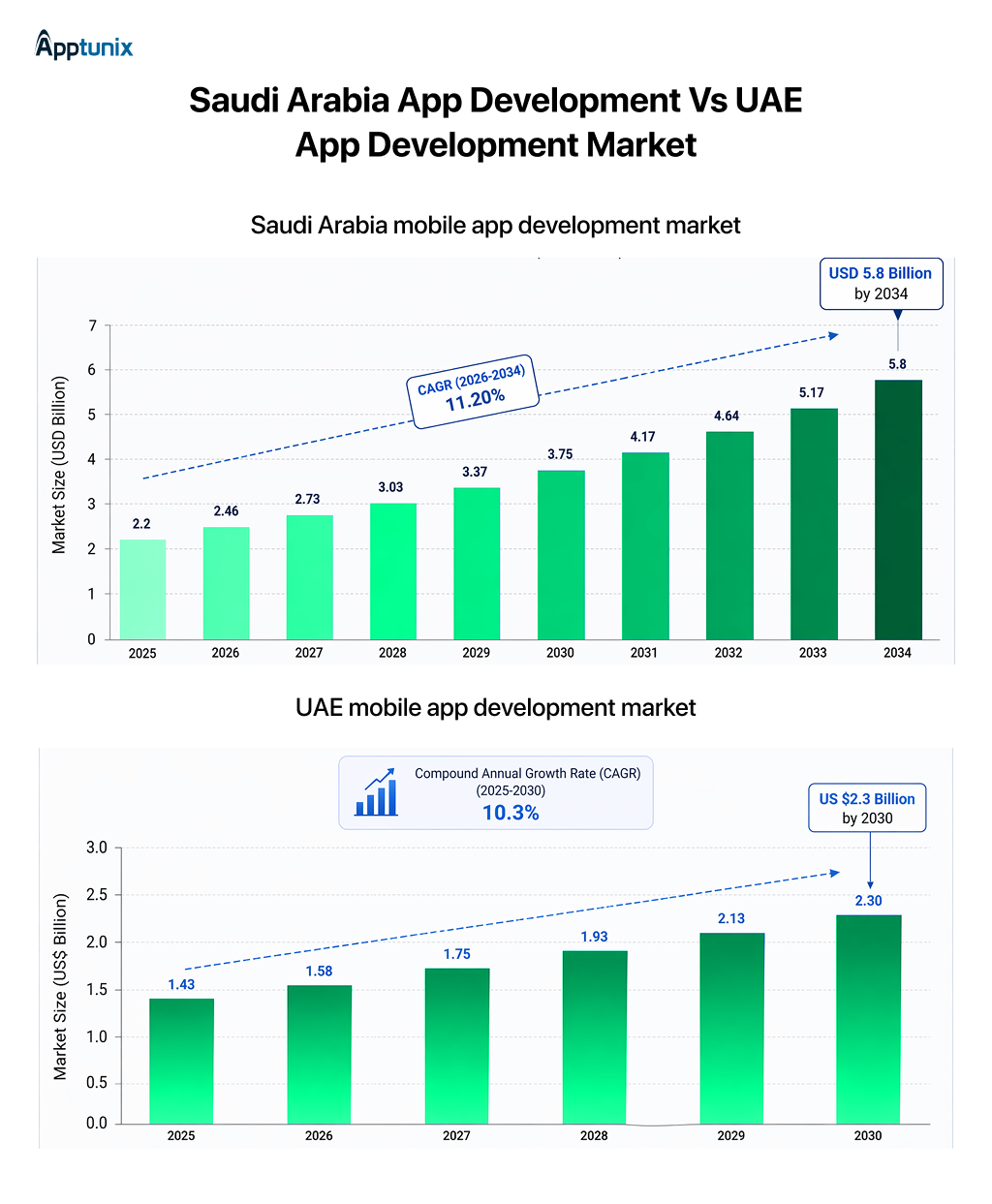
On paper, both markets look strong. Saudi Arabia’s app economy is already at $2.2B and pushing toward $5.8B by 2034. The UAE, meanwhile, is quietly compounding toward $2.3B with steady, premium-driven growth. But founders don’t invest in market size alone; they invest in outcomes.
And that’s where the real question shifts.
It’s no longer just an app development cost comparison between the UAE and Saudi Arabia. It’s about what those costs actually buy you: speed to launch, access to talent, regulatory friction, and long-term ROI.
Because in this region, where you build your app, it isn’t just a cost decision. It’s a strategy.
Let’s compare both markets from a cost and ROI perspective and determine which one is better.
In both regions, app development costs vary widely depending on the complexity of the application you want to create.
The cost to create an app in Dubai, UAE, ranges from AED 25,000 (for a basic MVP app) to AED 300,000+ (for a highly complex app).
On the other hand, the cost to make an app in Saudi Arabia ranges from SAR 30,000 (for an MVP) to SAR 400,000+ (for an enterprise-level app).
Here are more detailed details on the cost difference of mobile app development UAE vs KSA.
| Cost Type | UAE | Saudi Arabia |
|---|---|---|
| MVP Development (Basic) | AED 25,000 – 60,000 | SAR 30,000 – 60,000 |
| Med-level Development | AED 60,000 – 150,000 | SAR 60,000 – 160,000 |
| Enterprise-level Development | AED 150,000 – 300,000+ | SAR 160,000 – 400,000+ |
| Freelance Dev Teams | AED 90 – 150/hr | SAR 80 – 200/hr |
| In-house Dev Teams | AED 35,000 – 80,000/mo | SAR 30,000 – 70,000/mo |
| Offshore Dev Team | AED 60 – 120/hr | SAR 60 – 150/hr |
But pricing alone doesn’t tell the full story. The real differentiator often lies in talent availability.
There are mainly four options you will find for mobile app development solutions in Dubai, UAE, and Saudi Arabia.
Here’s the availability comparison for the UAE vs KSA Dev teams.
| Dev Teams' Availability | UAE | KSA |
|---|---|---|
| Local Freelancers | High — large pool, especially Dubai & remote MENA talent | Medium — growing fast, smaller than the UAE |
| In-House Team | Very High — mature hiring ecosystem and startup talent market | High — strong growth driven by Vision 2030 |
| Off-Shore Agency | Very High — easy access to Indian and Eastern European vendors | High — widely used, especially hybrid outsourcing models |
| Local Agency | Very High — highly mature agency ecosystem | High — rapidly expanding, strongest in Riyadh & Jeddah |
As you can see in the table, the UAE offers a more mature and instantly accessible developer ecosystem, while Saudi Arabia is rapidly catching up with strong enterprise and government-led digital investments.
Knowing who builds your app is one part of the equation. The bigger question is what actually drives the cost behind it.
A lot of founders still ask the wrong question. They ask, “Is UAE more expensive than Saudi Arabia?” The better question is, what exactly is driving the number?
When teams compare the factors influencing mobile app development cost in UAE vs Saudi Arabia, the market is only one part of the equation. The bigger drivers usually sit inside product scope, user expectations, and scale plans.
Here’s what actually moves the budget.
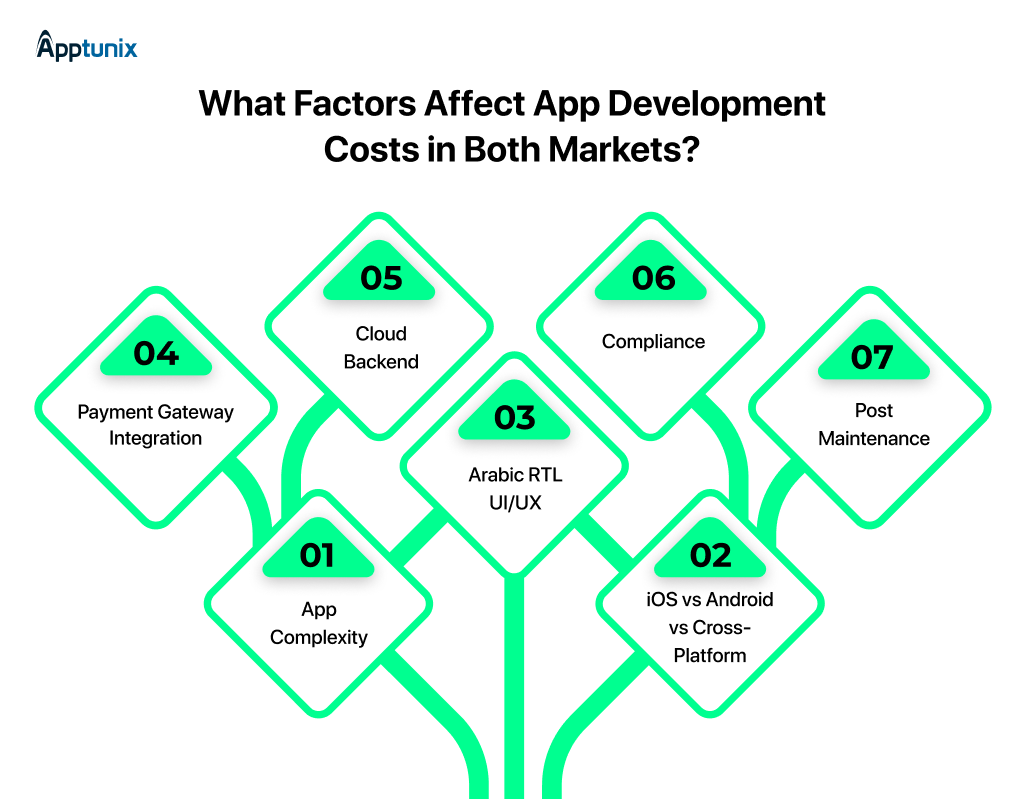
Honestly, complexity matters more than country. A simple booking app, internal dashboard, or marketplace MVP can stay within a manageable budget.
The moment you add live chat, role-based access, AI features, logistics tracking, dashboards, or multi-vendor workflows, the cost curve changes fast.
Founders often underestimate how quickly “just one more feature” turns into extra sprints.
That’s why the Arabic app development cost comparison between both markets can look misleading if one quote is for an MVP and the other is for an enterprise-grade product.
| Features' Cost in the UAE | Features' Cost in Saudi Arabia |
|---|---|
| AED 12,000 – 20,000 | SAR 15,000 – 25,000 |
Most founders and investors say they want both iOS and Android from day one without asking whether the market actually needs it.
Native iOS and Android builds give better performance and platform-specific polish. But they also mean separate development tracks, more testing, and higher maintenance.
Cross-platform app development frameworks like Flutter or React Native can reduce early-stage cost and speed up launch. For startups, this approach is often the smarter play.
| Launch Platform | UAE | KSA |
|---|---|---|
| iOS | AED 8,000 – 12,000 | SAR 8,500 – 12,000 |
| Android | AED 8,000 – 12,000 | SAR 8,500 – 12,000 |
| Cross-Platform | AED 10,000 – 15,000 | SAR 9,000 – 15,000 |
This one gets missed a lot, especially by teams outside the GCC. Arabic-first products are not just about translation.
RTL layouts change navigation logic, alignment, content flow, typography choices, and even how users scan screens.
This is a major part of any serious Arabic app development cost comparison. If this layer is rushed, adoption suffers quickly because users notice the friction immediately.
In GCC markets, poor localization can directly hurt trust and retention.
| Arabic UI/UX Cost UAE | Arabic UI/UX Cost Saudi Arabia |
|---|---|
| AED 5,000 – 10,000 | SAR 5,500 – 10,000 |
Payments always look simple in planning decks. Then the implementation starts.
In the UAE and Saudi Arabia, support for regional payment preferences matters a lot.
That could mean integrating providers like Stripe, Inc., Amazon.com, Inc. Pay, or local banking gateways, depending on the business model. This affects conversion rates directly. If checkout friction is high, acquisition spend gets wasted.
| API Cost UAE | API Cost Saudi Arabia |
|---|---|
| AED 6,000 – 9,000 | SAR 7,000 – 10,000 |
A lot of early budgets ignore backend architecture depth. Frontend screens are visible, so founders focus there first. But the backend is where scaling costs begin.
If the product expects fast user growth in GCC markets, backend quality becomes a revenue issue.
This is one of the biggest factors influencing mobile app development cost in UAE vs Saudi Arabia, especially for SaaS and marketplace products.
| Database Cost in the UAE | Database Cost in Saudi Arabia |
|---|---|
| AED 5,000 – 8,000 | SAR 6,000 – 10,000 |
Most teams ignore compliance until enterprise clients start asking about UAE PDPL, or Saudi PDPL, and data residency requirements.
Then suddenly, privacy policies, consent flows, audit logs, and secure hosting add to the build scope.
In the UAE and Saudi Arabia, this directly impacts app architecture and cost, especially for fintech, healthtech, and enterprise SaaS products.
| Compliance Cost in the UAE | Compliance Cost in Saudi Arabia |
|---|---|
| AED 8,000 – 12,000 | SAR 10,000 – 15,000 |
Launch is not the expensive part. Keeping the product reliable is. OS updates, bug fixes, feature iterations, performance upgrades, security patches, and analytics improvements continue every month.
This is where many founders underestimate runway requirements. The first build gets investor attention.
The post-launch maintenance cost affects burn rate and growth flexibility. For operators, this is the number that really matters over 12–24 months.
| Post-app Support UAE | Post-app Support Saudi Arabia |
|---|---|
| AED 50 – 200/hr | SAR 50 – 300/hr |
Once you understand what drives pricing, the focus shifts to where those investments create the most value.
This table breaks down key ROI factors in app development in the UAE vs Saudi Arabia for modern businesses.
| Aspects | UAE | Saudi Arabia |
|---|---|---|
| Market Maturity | Highly mature, global business hub with established infrastructure | Emerging but rapidly growing under Vision 2030 |
| Market Size | Smaller population (~10M), high purchasing power | Large population (~36M), strong domestic demand |
| Ease of Doing Business | Very high; streamlined setup, free zones, 100% foreign ownership | Improving fast; reforms ongoing, but still slightly complex |
| Startup Ecosystem | Strong ecosystem (Dubai, Abu Dhabi), access to global investors | Growing ecosystem, strong government-backed initiatives |
| Government Incentives | Free zones, tax benefits, investor-friendly policies | Heavy funding, grants, and support via Vision 2030 programs |
| Cost of Operations | Higher (rent, salaries, licensing) | Lower operational costs comparatively |
| Speed to Market Entry | Faster setup and go-to-market | Slower than the UAE but improving |
| Long-Term Growth Potential | Stable, but incremental growth | High growth potential due to economic transformation |
| Industry Opportunities | Finance, tech, tourism, logistics | Infrastructure, manufacturing, fintech, giga-projects |
| Competition Level | High competition, saturated in some sectors | Less saturated, more untapped opportunities |
At this point, the ROI looks clear. But this is exactly where many founders miscalculate.
Most founders underestimate app budgets, not because they miss the build cost, but because they only price the launch.
The real spending starts after version one goes live.
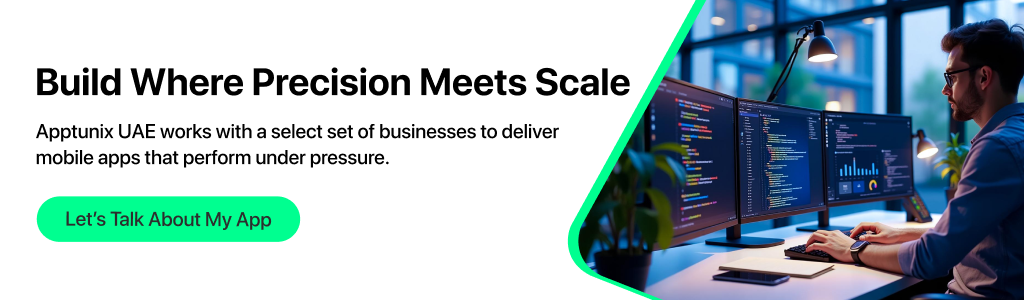
Teams compare mobile app development cost in UAE vs Saudi Arabia purely on agency quotes, then get surprised 3–6 months later when operational costs start stacking up. That’s where budgets quietly drift.
If you’re building in the GCC, these are the costs that usually get missed.
The app works today. Great. But mobile ecosystems move fast. iOS and Android updates break flows, devices change, APIs deprecate, and bugs start showing up at scale.
In the enterprise mobile app development GCC space, maintenance is rarely optional. A good rule is to keep 15–25% of the initial build cost annually reserved for maintenance alone.
That means if your cost to build an app in Dubai is AED 120,000, you should already be thinking about another AED 18,000–30,000 per year just to keep it stable.
Early-stage teams usually ignore hosting because the first bill looks harmless. Then user activity grows. It means more logins, more images, more push notifications, more API calls. Suddenly, your AWS, Azure, or Google Cloud invoice looks very different.
In the UAE and Saudi markets, apps with Arabic-first users often need fast regional delivery, CDN layers, and stronger uptime expectations. That pushes hosting costs higher than many founders expect.
What starts as AED 1,000–2,000 per month can easily scale into five figures for active products. The cost jump is rarely linear.
Both Apple Inc. App Store and Google LLC Play Store take their cut whether you choose iOS or Android app development solutions in Dubai, UAE, or KSA. For subscriptions and in-app purchases, the percentage quickly becomes meaningful. For SaaS products, this hits margins hard.
A founder may focus on customer acquisition cost, but forget platform commissions sitting on top of every paid user. For investors looking at unit economics, this directly changes payback periods.
Most teams start with free analytics. That works for the MVP stage. But once you need funnel visibility, cohort retention, event tracking, attribution, or enterprise dashboards, you move into paid tools.
Platforms like Mixpanel, Amplitude, and Firebase premium tiers are not cheap at scale. This is one of the hidden costs founders rarely include when comparing mobile app development cost in UAE vs Saudi Arabia.
In GCC markets, trust is a commercial infrastructure. If you’re handling payments, customer data, logistics workflows, healthcare, or enterprise access, security can’t be an afterthought.
Penetration testing, secure authentication, encryption layers, compliance audits, and access controls all add cost. This is especially true for enterprise mobile app development GCC products selling to larger organizations.
Growth itself becomes expensive. More users mean backend upgrades, database optimization, faster support teams, better monitoring, and stronger infrastructure redundancy.
The app that worked for 5,000 users may struggle at 100,000. Founders celebrate traction while engineering costs double in the same quarter.
That’s why the cost to build an app in Dubai or Saudi Arabia should never be viewed as a one-time project budget. It’s an operating system cost.
At some point, every founder circles back to the same realization: mobile app development cost in UAE vs Saudi Arabia isn’t about cheaper or more expensive; it’s about alignment. The market you choose shapes how fast you move, how well you scale, and how long your advantage lasts.
That’s exactly where working with the right mobile app development company Dubai, UAE changes the equation. At Apptunix UAE, we’ve seen firsthand how the right build decisions translate into faster launches, cleaner architectures, and products that actually hold up under growth.
Not by overbuilding, but by building what matters, when it matters. From navigating GCC compliance to crafting Arabic-first experiences and scalable backends, the focus stays on outcomes, not just delivery.
If you’re weighing your next move, the smarter investment often starts with a clearer conversation.

Q 1.Is app development cheaper in Saudi Arabia than in the UAE?
Not necessarily. Saudi Arabia can appear slightly more affordable on paper, especially for mid-to-large builds, but the gap isn’t dramatic. What really matters is what you’re building. In many cases, the mobile app development cost in UAE vs Saudi Arabia evens out once you factor in speed, talent access, and execution quality. Cheaper doesn’t always mean better ROI.
Q 2.How much does an MVP cost in Dubai?
An MVP in Dubai typically ranges between AED 25,000 and AED 60,000+, depending on features, platform choice, and complexity. Costs can go higher if you’re building for scalability or adding advanced features early.
Q 3.What is the average app development cost in Riyadh?
In Riyadh, app development costs usually start from SAR 30,000 for MVPs and can go up to SAR 400,000+ for enterprise-level applications. The pricing is competitive, but timelines and ecosystem maturity can influence overall delivery.
Q 4.How much do iOS and Android app stores cost to launch an app?
Launching on app stores is relatively low-cost compared to development. The Apple App Store charges around $99 per year, while Google Play requires a one-time $25 fee. However, if you’re investing in iOS app development services Dubai UAE, it’s important to look beyond just listing fees. The real cost impact comes from platform commissions on in-app purchases and subscriptions, which can significantly affect long-term revenue.
Q 5.Which GCC market gives better ROI?
It depends on your strategy. The UAE offers faster market entry, premium users, and a mature ecosystem. Saudi Arabia brings scale, lower competition, and long-term growth potential. ROI is less about upfront cost and more about how well your product fits the market.
Q 6.Does the Arabic app support increase the cost?
Yes, but it’s a necessary investment. Arabic support goes beyond translation. It requires RTL design, UX adjustments, and proper localization. This can increase development costs, but skipping it often leads to poor adoption in GCC markets.
Get the weekly updates on the newest brand stories, business models and technology right in your inbox.
With over 20+ years of experience in driving global digital initiatives, Nikhil Bansal is the CEO & Director of Apptunix. He specializes in orchestrating large-scale digital transformations, enterprise-grade software solutions, and high-level business strategies that redefine industry standards. Nikhil is known for his ability to bridge the gap between complex business challenges and innovative technology, helping Fortune 500 companies and startups alike achieve sustainable growth. A visionary leader, he empowers enterprises to navigate the digital landscape with agile, ROI-focused models and future-ready business strategies.
14 Views 7 min July 31, 2026

42 Views 7 min July 27, 2026
127 Views 7 min June 2, 2026
Offer Ends Soon
Get a quick expert response in under 5 minutes.