
How to Increase ROI with Performance Marketing in Dubai: A Complete Guide for Growing Businesses
14 Views 7 min July 31, 2026

With over 20+ years of experience in driving global digital initiatives, Nikhil Bansal is the CEO & Director of Apptunix. He specializes in orchestrating large-scale digital transformations, enterprise-grade software solutions, and high-level business strategies that redefine industry standards. Nikhil is known for his ability to bridge the gap between complex business challenges and innovative technology, helping Fortune 500 companies and startups alike achieve sustainable growth. A visionary leader, he empowers enterprises to navigate the digital landscape with agile, ROI-focused models and future-ready business strategies.

Two quotes land on the same desk. One from Dubai. One from Riyadh. The UAE number is 40% higher. Easy decision, right?
The answer is wrong.
Saudi Arabia's enterprise software market is growing at a 14.5% CAGR. It'll hit $10.3B by 2033. On the other hand, the UAE is at a 12% CAGR, reaching $11.3B by 2030.
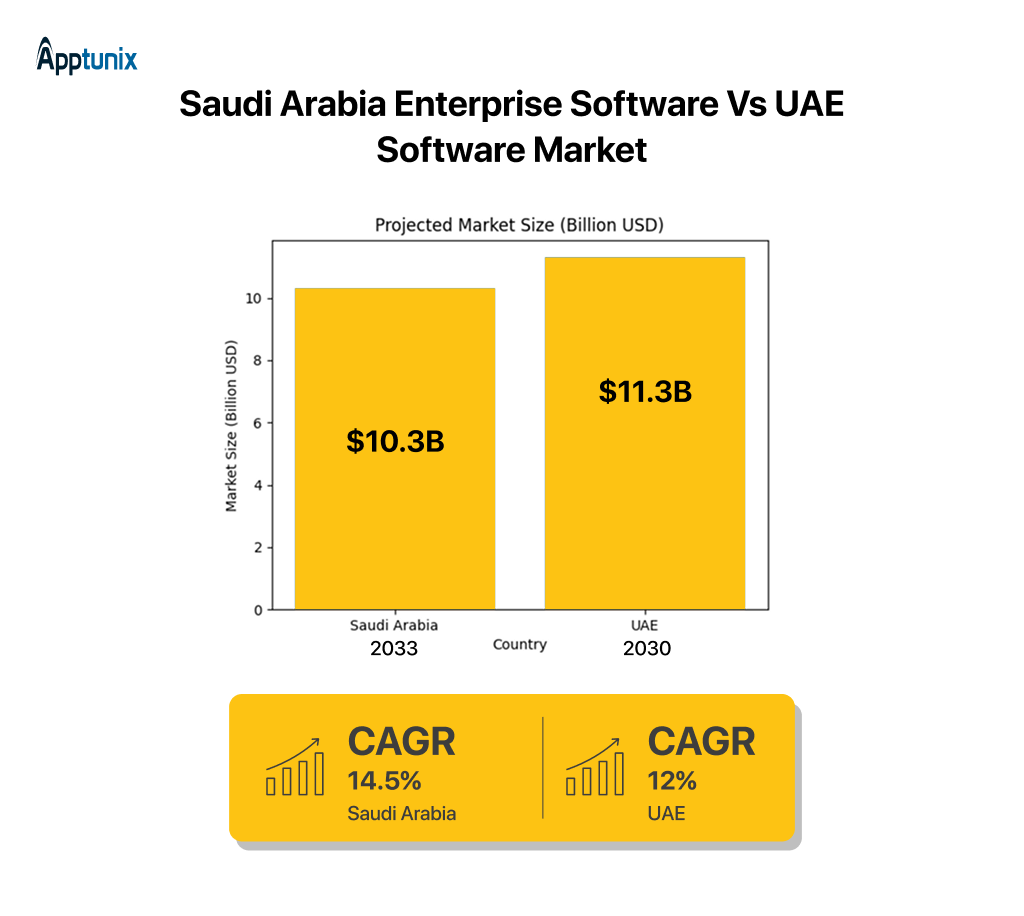
Both markets are experiencing significant growth. But here's what the glossy pitch decks don't show. The cheaper quote often comes with hidden costs. And the expensive one? Sometimes it's just padding from agencies that assume every enterprise budget can absorb premium agency markups.
Founders keep comparing hourly rates in the UAE and Saudi Arabia. Investors keep asking for line-item breakdowns. But neither gets to the real question.
Where will your first enterprise customer actually deploy?
Because a CRM built for Dubai's free zones breaks into Riyadh's data centers. An ERP that passes the UAE's DIFC audit fails Saudi's PDPL on day one.
That's why the software development cost in UAE vs Saudi Arabia isn't a math problem. It's a market entry question dressed up as a budget spreadsheet.
And for anyone serious about enterprise software development cost GCC, the lowest bid is rarely the cheapest. Here's what actually moves the needle.
When enterprises compare software development costs in the Middle East, the conversation often comes down to UAE vs Saudi Arabia. While both markets are experiencing rapid digital transformation, the pricing structure, compliance costs, talent rates, and project timelines vary significantly.
Here’s the full cost breakdown for the UAE vs Saudi Arabia:
To make informed technology decisions, it’s important to break down the development cost based on the type of software being built.
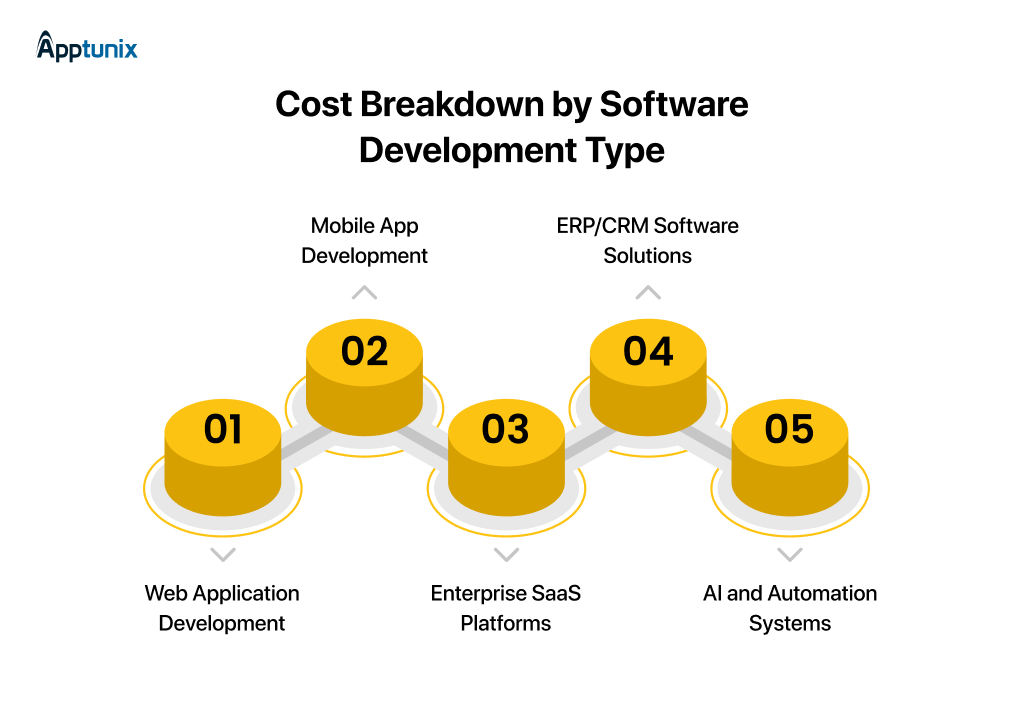
Most founders start here. A solid B2B web app with auth, dashboards, and basic integrations.
Why the gap? UAE has more senior product-minded devs who’ve built for global scale. Saudi Arabia has hungry mid-level teams with lower overhead.
But here’s the trap: cheap Saudi dev shops often skip documentation. That hurts later. You should rather pay the UAE premium for clean web app development services if you plan to raise it.
Real impact: If you’re bootstrapped, start in KSA. If you have a cost to build SaaS platform in UAE and Saudi Arabia under $50k, go to the UAE and negotiate hard.
The UAE has more battle-tested mobile development teams who’ve shipped to the App Store multiple times. That matters for consumer apps.
Why companies care: If your users are in KSA, build there; they understand local payment gateways and Arabic UX better. If you need global polish, pay UAE development rates.
Think about multi-tenant, SSO, audit logs, and compliance. KSA development teams often underestimate compliance work (NDMO, CST, etc.). UAE teams have done it before.
Practical take: Use a software project cost calculator UAE before committing. Most agencies in DIFC will give you a rough range for free. Saudi agencies? Less transparent. Ask for past enterprise case studies.
Custom ERPs are expensive everywhere. But the gap is smaller here because domain knowledge matters more than location.
The real difference is maintenance. UAE firms charge $10k–$15k/month for support. Saudi firms charge $6k–$10k.
But Saudi support can be slow. If your business runs on that ERP, downtime costs you more than the savings.
Observation: Don’t go for a custom CRM development in Dubai unless you absolutely have to. Buy Zoho or Odoo first. If you must build, do it in Saudi Arabia, but demand SLAs in writing.
AI talent is actually more available in KSA right now.
Why? Saudi Arabia’s big AI push (SDAIA, NEOM) has created a pool of local ML engineers who’ve worked on government-scale projects. The UAE has more consultants who repackage OpenAI APIs.
Real business impact: For basic automation (chatbots, data extraction), the software outsourcing cost in Saudi Arabia is lower, and the quality is fine. For cutting-edge LLM fine-tuning? The UAE has the edge.
Both the UAE and Saudi Arabia are leading the digital transformation in the GCC. The cost of software development can vary significantly based on multiple business and technical factors.
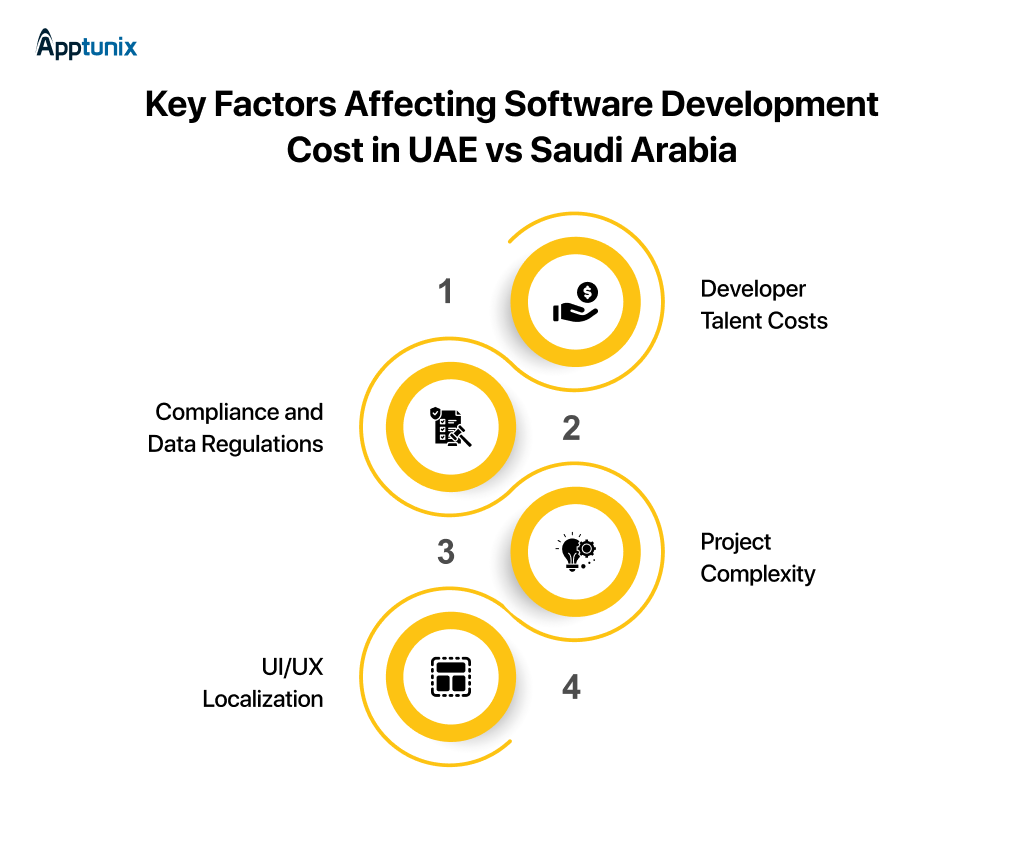
KSA developers aren't that much cheaper anymore.
A good full-stack dev in Riyadh is 18k–25k SAR/month ($4.8k–$6.7k). Same person in Dubai? 22k–30k AED/month ($6k–$8.2k). The gap shrank to about 20%.
Why this matters for your budget: A lower salary doesn't mean a lower software development cost in the UAE or Saudi Arabia if you're constantly rehiring and retraining. Factor in 15–20% turnover padding for Saudi teams.
The UAE has a DIFC data protection law. Saudi Arabia has PDPL. Both are GDPR-ish. But enforcement is totally different.
In the UAE, you can launch first and fix compliance later. Audits are rare unless you screw up.
In Saudi Arabia, regulators actually check. A fintech startup was fined 2M SAR before its first customer because it stored user data on a Dubai server without approval.
Real business impact: Add 30–40% to your timeline for Saudi compliance. Add legal fees. Add a local data officer if you handle personal data.
If you're comparing Software Development Cost in UAE vs Saudi Arabia, compliance is often the hidden 50k–100k USD difference nobody quotes upfront.
Simple CRUD app? Build it anywhere. The price difference is small. But here's where it gets interesting.
UAE devs are better at architectural complexity. Multi-tenant systems. Real-time sync. Custom auth flows. They've built for global scale before.
Saudi devs excel at integration complexity. Connecting to local payment gateways (Mada, Sadad). Government APIs (Absher, Qiwa). Logistics systems.
Build the complex core in the UAE. Outsource the local integrations to Saudi Arabia. Saves about 25% total vs doing everything in one country.
And for software outsourcing cost in Saudi Arabia, complex projects actually scale better there than simple ones. Why? Fixed-price contracts. Saudi agencies love a fixed price for complex work. UAE prefers time and materials.
UAE designers charge a premium of 10k–15k AED per screen for high-end work. But they understand global UX patterns. Saudi designers are cheaper. But they know local behavior cold.
Example: Saudi users scroll more. They prefer right-aligned Arabic with larger touch targets. They expect dark mode by default. UAE designers often miss these details.
The cost trap: teams build beautiful UAE-designed apps that Saudi users hate. Then they pay another 80k SAR to redo the frontend locally.
My rule: Do UX research in the target country first. Not last. A 5k USD usability test in Riyadh saved me 60k in rebuild costs.
Enterprises compare software development costs in the UAE vs Saudi Arabia to optimize ROI and market-fit. Let’s see the reasons.
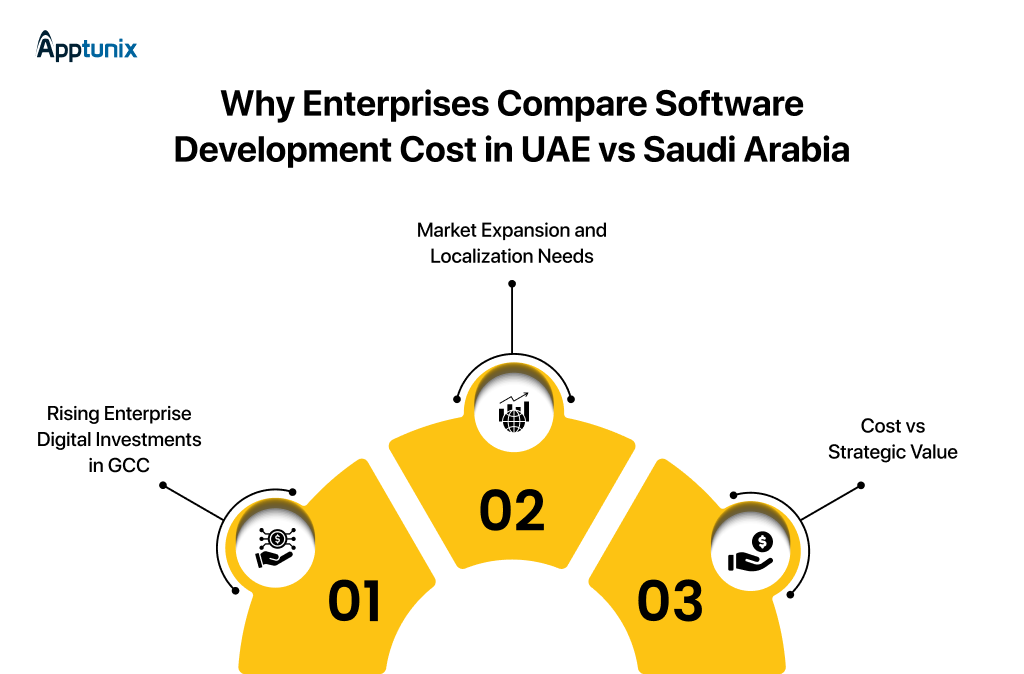
Two years ago, most SaaS founders treated the Gulf as one big “UAE-plus” market. That’s dead now.
Enterprises are actively comparing software development costs in UAE vs Saudi Arabia before signing any SOW. Why? Because the gap isn’t just 10–15%. It can be 40% once you factor in talent availability, visa overhead, and office requirements.
Here’s the blunt observation: UAE is mature but expensive. Saudi is hungry but chaotic. If you’re asking how much does software development cost in UAE, the real answer is “it depends on how much red-ticket premium you’re willing to pay for speed and stability.”
Enterprises don’t compare costs just to save money. They compare because they have to localize.
A bank expanding into Saudi can’t use a UAE-built CRM without heavy modifications. Arabic dialects, payment gateways, and regional compliance layers. So they ask, do we rebuild here or there?
Three B2B startups picked Saudi for their next dev hub purely because the custom software development cost in Saudi Arabia came in under half of Abu Dhabi’s rates. But they also underestimated integration pain. Local hosting, slower cloud services, hiring senior talent, it adds up.
The smart ones run a blended model: the UAE for the product core and Saudi Arabia for localization layers and govtech modules.
Most founders treat “cheaper” as “better.” But enterprises compare software development costs in UAE vs Saudi Arabia to figure out optionality, not just burn rate.
A Saudi-built product gives you better access to PIF-backed entities. A UAE-built product scales faster across Dubai’s free zones. That’s strategic value, not line-item cost.
My rule of thumb now: if you need enterprise sales within six months, build in UAE and pay the premium. If you’re playing the long localization game (2–3 years), move dev to Saudi early, even if it’s messier today.
Here’s a strategic comparison of ROI opportunities across the UAE and Saudi Arabian markets.
So here’s the truth: no one puts in a proposal. Comparing software development costs in the UAE vs Saudi Arabia isn’t about finding the cheapest line item. The key is to identify the most suitable option for your go-to-market strategy. Pick wrong, and those “savings” vanish fast.
At Apptunix UAE, we’ve helped dozens of enterprises stop guessing and start building with clarity. Here’s what that actually looks like:
Whether you need a software development company UAE or a software development company in Saudi Arabia, we offer services for both.
You don’t need another spreadsheet. You need a partner who’s already walked this path.
Ready to stop comparing quotes and start shipping? Let’s talk.

Q 1.Is software development more affordable in Saudi Arabia than the UAE?
In most business cases, Saudi Arabia tends to be more cost-efficient than the UAE, especially for mid-scale and enterprise software projects. Development teams in KSA generally operate with lower overhead costs, which often results in reduced hourly rates and project budgets. However, affordability should not be judged by the initial quote alone. Compliance requirements, local integrations, and long-term support costs can significantly impact the final investment.
Q 2.What is the typical cost of enterprise software development in the UAE?
Enterprise software development in Dubai, UAE usually falls within the range of AED 250,000 to AED 900,000 or more, depending on the scope and technical complexity. Projects such as SaaS platforms, ERP systems, and compliance-heavy enterprise solutions typically require a larger budget due to advanced architecture, security layers, integrations, and ongoing maintenance requirements.
Q 3.Which country is better for SaaS product development in the GCC?
The answer depends on your growth strategy. The UAE is often a stronger choice for companies looking to launch quickly with access to experienced product teams and mature digital infrastructure. Saudi Arabia, however, is highly effective for businesses planning deeper localization and long-term enterprise expansion within the GCC. A blended-approach product core in the UAE and localization in KSA often deliver the best outcome.
Q 4.Which country is better for SaaS product development in the GCC?
The answer depends on your growth strategy. The UAE is often a stronger choice for companies looking to launch quickly with access to experienced product teams and mature digital infrastructure. Saudi Arabia, however, is highly effective for businesses planning deeper localization and long-term enterprise expansion within the GCC. A blended-approach product core in the UAE and localization in KSA often deliver the best outcome.
Q 5.What does mobile app development usually cost in Saudi Arabia?
The cost of mobile app development in Saudi Arabia can vary based on app complexity, features, and integrations. A basic MVP may start from SAR 40,000–60,000, while more advanced business or enterprise-grade applications can range from SAR 100,000 to SAR 300,000+. Apps involving fintech, logistics, or custom workflows may require a higher budget.
Q 6.Who offers stronger tech talent: UAE or Saudi Arabia?
Both markets offer strong technology talent, but their strengths differ. The UAE is known for experienced senior developers, solution architects, and product-focused teams that are well-suited for scalable SaaS and enterprise builds. Saudi Arabia is rapidly growing in areas such as AI, automation, and government-focused digital solutions, making it a strong market for localized enterprise software.
Q 7.What usually increases software development costs?
Several factors can push software development costs higher, including project complexity, custom integrations, compliance requirements, UI/UX localization, and faster delivery timelines. In GCC markets, legal frameworks, local hosting rules, and enterprise-grade security standards are often major cost drivers that businesses should plan for early.
Q 8.Which market is better for long-term enterprise growth?
For long-term enterprise expansion, Saudi Arabia often presents a larger growth opportunity due to its market size, government digitization initiatives, and increasing enterprise technology investments. The UAE remains ideal for faster launches and investor access, while KSA offers stronger scale potential for long-term revenue growth.
Get the weekly updates on the newest brand stories, business models and technology right in your inbox.
With over 20+ years of experience in driving global digital initiatives, Nikhil Bansal is the CEO & Director of Apptunix. He specializes in orchestrating large-scale digital transformations, enterprise-grade software solutions, and high-level business strategies that redefine industry standards. Nikhil is known for his ability to bridge the gap between complex business challenges and innovative technology, helping Fortune 500 companies and startups alike achieve sustainable growth. A visionary leader, he empowers enterprises to navigate the digital landscape with agile, ROI-focused models and future-ready business strategies.
14 Views 7 min July 31, 2026

42 Views 7 min July 27, 2026
156 Views 7 min April 27, 2026
Offer Ends Soon
Get a quick expert response in under 5 minutes.